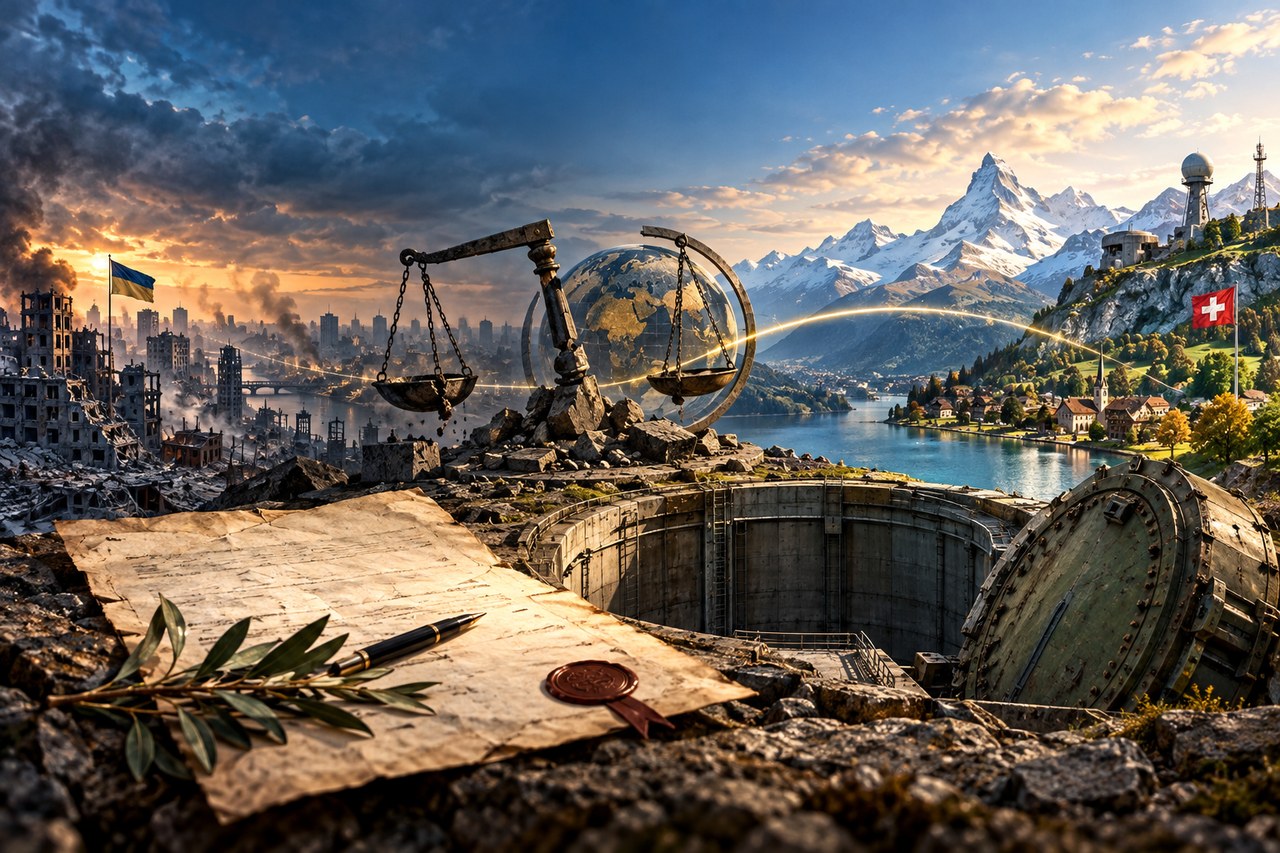
Core argument: International law remains indispensable. Without political will, credible deterrence and practical protection mechanisms, however, it cannot guarantee a state's security on its own.
Assurances that did not become a shield
Washington, White House, 22 November 1994. US President Bill Clinton met Ukraine's President Leonid Kuchma. Clinton publicly praised Ukraine's decision to give up its nuclear arsenal and join the Treaty on the Non-Proliferation of Nuclear Weapons.
On 5 December 1994, Ukraine, the United States, the United Kingdom and Russia signed the Budapest Memorandum. In connection with Ukraine's renunciation of the Soviet nuclear weapons left on its territory, Ukraine received security assurances. These included respect for its independence, sovereignty and existing borders, as well as a commitment to refrain from the threat or use of force.
At the time, the step was seen as a contribution to a more secure future for Europe. The international system was meant to show that security could rest not only on military strength, but also on rules and commitments.
History took a different course. In 2014, Russia occupied Crimea and began armed aggression in eastern Ukraine. In February 2022, it launched a full-scale invasion. The state that had assured Ukraine's sovereignty and territorial integrity violated those principles itself.
The war has destroyed cities, forced millions to flee and killed soldiers and civilians, with immense human losses. This is not only a Ukrainian tragedy; it is a test of the international security system.
The Budapest Memorandum: more than broken promises
The Budapest Memorandum was not equivalent to NATO's collective-defence treaty. It contained security assurances, but no automatic guarantee of assistance. In particular, it did not oblige the United States or the United Kingdom to go to war militarily against an aggressor if Ukraine were attacked.
An attacked state may therefore hope for diplomatic support, sanctions and international condemnation and still face a much stronger military opponent. That is the central problem: international assurances are not the same as guaranteed military protection.
After the Soviet Union dissolved, the world's third-largest nuclear arsenal was on Ukrainian territory. Operational control, command structures and technical infrastructure were complex. It would be inaccurate to claim that Ukraine could simply have operated the entire arsenal independently, without major technical and political obstacles. It would be equally wrong to ignore the strategic lesson: giving up nuclear potential without a reliable deterrence system carries long-term risks.
Where practical protection mechanisms are absent, the effectiveness of international agreements depends substantially on the political will of their signatories.
Washington: when political priorities affect a partner's security
US policy under Donald Trump shows how strongly foreign-policy decisions can be shaped by political and economic interests.
A White House order dated 16 October 2026 implements the Lindsey O. Graham Sanctioning Russia and Iran Act. It provides for a 500 per cent increase in tariff rates on goods from Russia. Further tariffs of 100 per cent are envisaged for goods from the five largest importers of Russian crude oil and natural gas if they make new purchases after 18 October. Goods from the five leading countries that help evade Russian oil sanctions are also covered. The order expressly provides for exceptions and waivers.
At the same time, the President says that numerous tariff, sanctions and restriction provisions of the Act will not be applied in the national interest of the United States. The order also states that earlier sanctions under other presidential orders remain in force. It therefore combines new tariff requirements with broad exceptions. This does not mean that every US decision is directed against Ukraine, or that US support has been fully withdrawn. It does show how heavily security and sanctions policy can depend on political decisions.
This dependence matters especially for Ukraine. Arms deliveries, intelligence, funding and political support can directly affect the situation on the battlefield. No country should base its long-term security solely on the goodwill of another, even if that country is the world's most powerful military power.
A dependable partnership requires predictability, continuity and the ability to provide practical help in a crisis. Political statements alone are not enough.
The UN: international law without sufficient means of enforcement
The Charter of the United Nations prohibits the threat or use of force against the territorial integrity or political independence of any state. This prohibition is one of the foundations of modern international law.
But what happens when an alleged violator of the law is itself a permanent member of the Security Council? On 25 February 2022, Russia vetoed a draft resolution on the attack against Ukraine. Eleven Council members supported the draft; the veto of one permanent member prevented its adoption.
In early March, the General Assembly adopted a resolution condemning the aggression and calling on Russia to end the violence and withdraw its troops from Ukraine. This was diplomatically significant, but it did not stop the fighting or create a military enforcement mechanism.
The General Assembly can build common positions, adopt resolutions and generate political pressure. The Security Council has broader powers on peace and security, but the permanent members' veto limits its ability to act when one of them is itself a party to a conflict.
The problem is not that international law does not exist. Rather, there is no universal mechanism that can automatically and reliably compel a nuclear power to comply with the rules. The UN remains an important platform for diplomacy, humanitarian aid and cooperation. Membership and resolutions, however, do not replace national defence.
Military strength as the material basis of deterrence
The war against Ukraine brings a fundamental question back into focus: what actually deters an aggressor from attacking? Treaties, diplomacy and economic ties matter, but they cannot guarantee peace in every circumstance.
If a government is willing to violate international norms and considers the expected cost of an attack acceptable, statements alone may not be enough. National security therefore needs a material foundation: combat-ready armed forces, modern air and missile defence, a capable defence industry, stable ammunition production, intelligence and cyber defence, as well as a resilient economy, energy supply and critical infrastructure.
These capabilities should make clear to a potential aggressor that an attack will not bring an easy victory and will exact a high price. Symbolic support must be distinguished from actual defence capacity. A resolution does not intercept a missile; a diplomatic statement does not stop a column of tanks.
Ukraine does not prove that international law is useless. It shows that without political will and the ability to defend its principles, international law alone cannot guarantee a state's survival.
Nuclear weapons: deterrence or a new trap?
Nuclear weapons are among the strongest instruments of strategic deterrence. Possession can force an opponent to take the risk of unacceptable losses in a direct attack into account. It does not follow that nuclear weapons are a universal solution for every country.
They carry enormous financial and technological costs, create risks of accidents and escalation, and can encourage other states to develop arsenals of their own. They also do not automatically protect against cyberattacks, sabotage, economic pressure, domestic destabilisation or limited military provocations.
Nuclear deterrence requires secure storage, reliable delivery systems, and responsible command and control. It works only if an opponent considers a possible response credible and the state can control its arsenal safely.
The strategic lesson is therefore not that every country should acquire nuclear weapons. Rather, disarmament and non-proliferation must be linked to effective security mechanisms. When states give up nuclear deterrents, the long-term risks must be assessed seriously and other means of protection made credible.
If the non-proliferation regime is to endure, giving up nuclear weapons must not leave a state defenceless against aggression. Otherwise, states may see their own military capabilities as more reliable than international assurances. That would undermine the whole logic of nuclear non-proliferation.
What the international community must learn
Ukraine's case presents democratic states with fundamental tasks.
First, political assurances must be clearly distinguished from legally defined defence obligations. States that limit their military capabilities need to know what concrete assistance they can rely on.
Second, security agreements should include clear response procedures, responsibilities and consultation mechanisms. Where possible, forms of support should be agreed in advance.
Third, international institutions need reforms that make it harder to block collective responses to aggression. This is difficult: changes to the UN Charter require broad support, while the permanent members' privileges are deeply embedded in the international order.
Fourth, states must invest in their own defence and resilience rather than handing all responsibility to international organisations or partners.
Finally, international law must remain the foundation of relations between states. Abandoning it would mean returning to a world where might openly replaces law. Preserving legal principles takes more than statements: they must also be protected in practice.
Switzerland: security is continual work
Against the background of Ukraine, Switzerland is particularly instructive. Traditionally, it has relied on permanent neutrality, its own defence capabilities, stable institutions and a predictable foreign policy.
Switzerland's security situation cannot be equated with Ukraine's, whose territory is affected by a full-scale military invasion. That does not mean Swiss security is guaranteed once and for all.
On 18 September 2026, the Federal Council adopted the Security Policy Strategy 2026. It sets out ten goals and 46 measures to strengthen resilience, protect the population and critical infrastructure, and expand defence capabilities. The authorities cite Russia's war of aggression against Ukraine, hybrid threats and critical dependencies as factors in a more uncertain environment.
Switzerland's approach does not mean the country is abandoning neutrality or treating international law as unimportant. Rather, it combines neutrality with a willingness to protect its territory, develop defence capabilities and cooperate with partners on security.
Neutrality is not a magic shield. It operates within a concrete state policy, supported by stable institutions and structures capable of defence. Switzerland's security also depends on stability in Europe and its neighbourhood.
Switzerland has functioning institutions, a clear security strategy and a peaceful environment that differs markedly from the conditions Ukraine faces. Even so, the Swiss government does not rely only on favourable circumstances; it is preparing for a more unstable world.
This is an important lesson for every state, regardless of size, prosperity, geographical position or political status. International law sets out how states should act. Diplomacy helps prevent conflicts, and alliances can strengthen security. But protecting one's own country remains a responsibility to be carried together with reliable partners.
Conclusion
Ukraine has paid an extraordinarily high price for the gap between international assurances and real protection. The world cannot act as though that experience has nothing to do with it.
If the twenty-first century is to remain an era of international law rather than return to the unrestrained rule of the strongest, violations of international norms must have real consequences. States that renounce weapons of mass destruction must not be left without reliable means of protection.
Otherwise, the lesson of Budapest will be understood not as proof that disarmament can make the world safer, but as a warning: no state should confuse a promise of security with the actual ability to provide it.