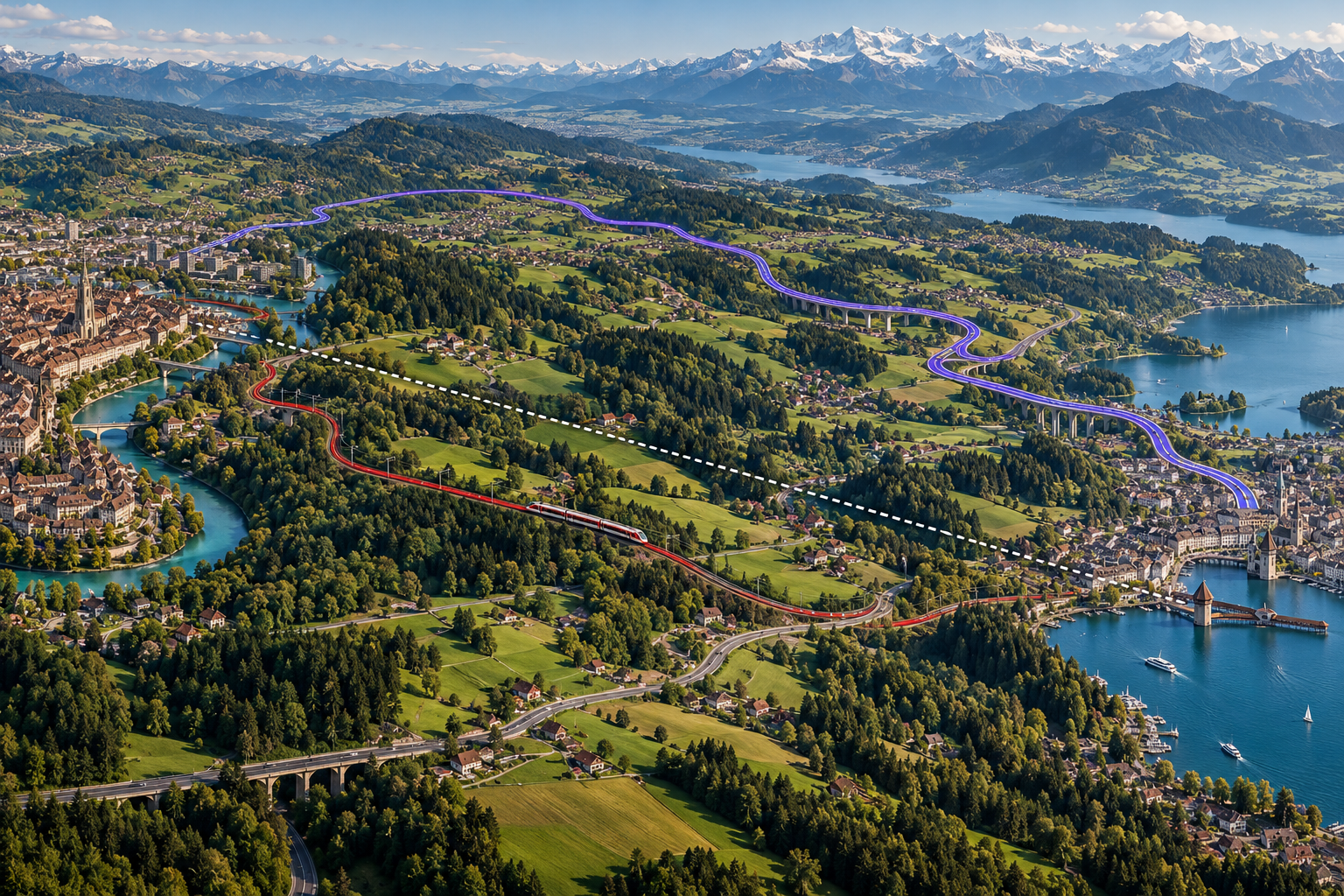
Social media and some regional outlets occasionally return to a question that seems paradoxical at first: why does driving between Bern and Lucerne take much longer than the straight-line distance between the cities, even though they are in one of Europe’s most developed countries?
Satellite maps do show a striking contrast. The straight-line distance is about 67 kilometres, while one of the road routes shown is roughly 110 kilometres. The exact distance depends on the starting point, destination and route. For some observers, the gap raises doubts about the efficiency of Swiss transport planning. [5]
A striking map, however, is not enough to support such a sweeping conclusion. To understand the situation, it is necessary to consider geography, the history of the network, existing alternatives and the actual priorities of public investment.
The key question is not why a road fails to follow a straight line, but whether connections between the two cities are organised sensibly and which improvements would truly be justified.
A straight line is not an infrastructure project
A straight-line distance is a geometric measure, not a road design. The hills of the Swiss Plateau, settlements, farmland and natural areas lie between Bern and Lucerne. A new expressway would have to account for terrain, road safety, bridges, possible tunnels, interchanges and links to the existing network.
Building a road is not an end in itself. It is justified when the expected social and economic benefits outweigh construction and operating costs and environmental consequences.
Even if a more direct route could be designed, that would not prove that building it was the best solution. Reliable estimates would be needed for traffic volumes, time savings, project costs and environmental effects.
We found no evidence that Swiss authorities examined a concrete proposal for a direct Bern–Lucerne motorway and then rejected it for a particular reason. Explaining the lack of a direct motorway as the result of a proven political ban, a veto by environmental groups or bureaucratic failure would therefore be speculative.
Direct rail connections already link Bern and Lucerne
Roads are only one part of the transport system. The BLS RegioExpress RE7 connects the two cities directly via Langnau im Emmental. The IR15 long-distance train also runs directly between Bern and Lucerne on a different rail route. The BLS and SBB timetables list these services. [1][2]
The network was not built solely to move passengers between two endpoints as quickly as possible. It also serves intermediate towns and is integrated into the national system.
Efficiency therefore cannot be judged by the kilometres between two cities alone. Frequency, journey time, timetable reliability, transfer options and access to stations also matter.
That does not mean the rail connection cannot be improved. Its quality should be judged by the service it provides passengers, not by how straight a line looks on a map.
What is Switzerland actually planning?
On 28 January 2026, the Federal Council set out key parameters for transport infrastructure development through 2045. On 19 June it adopted the consultation draft for “Verkehr ’45”. The consultation closed on 9 October 2026, and the government’s message to Parliament is planned for February 2027. The programme is intended to increase rail capacity step by step, reduce bottlenecks on national roads and develop transport infrastructure in urban areas. [3]
The planned improvements include half-hourly InterRegio trains between Bern and Lucerne from 2035. Around CHF 3 billion in total is earmarked for additional rail services by 2035. This is a planning target, not a service already in operation. [3]
The government is therefore not ignoring the Bern–Lucerne connection; it plans to increase rail frequency. But frequency and speed are different things. A half-hourly service does not automatically halve journey time. Additional infrastructure, greater capacity at transport hubs and coordination with the wider network may be needed.
Plans must not be confused with completed results. Their delivery depends on funding, detailed design and further decisions by the responsible authorities.
Why can even a wealthy country not modernise everything at once?
Switzerland has to maintain existing roads and railway lines, relieve overloaded sections, expand regional transport and fund major projects in different parts of the country at the same time.
Infrastructure projects compete for limited public funds. A new motorway, an upgraded rail hub and additional train services pursue different aims and can have different public benefits.
The planned through-station in Lucerne is an instructive example. It is intended to significantly improve the rail hub’s development options, but it is a major project requiring substantial investment and phased construction. It forms part of the network’s long-term expansion plans.
There is room for substantive criticism: Are the priorities sufficiently justified? Are the schedules realistic? Is the funding secured? Are federal authorities examining alternatives carefully enough?
These questions are far more useful than a simple comparison between road length and straight-line distance.
Criticism should be based on facts, not a visual impression
This does not mean Swiss transport policy is free of flaws. On the contrary, infrastructure costs, bottlenecks on individual routes and the quality of long-term planning raise legitimate questions.
On 14 September 2026, the Swiss Federal Audit Office published its audit of the “Verkehr ’45” programme. It found that important foundations for a transparent prioritisation were missing, that cost-effectiveness calculations for rail and road projects had serious weaknesses, and that alternatives to motorway expansion had not been examined systematically. It also found that funding for the projects planned through 2045, worth around CHF 50 billion, had not been demonstrated. [4]
These findings concern the infrastructure programme as a whole. They prove neither that a direct Bern–Lucerne motorway was examined and rejected for a specific reason nor that Switzerland necessarily needs a new expressway.
When a project becomes more expensive, its costs need to be examined. When trains are overcrowded, passenger numbers and line capacity need to be analysed. When deadlines slip, the reasons for the delays need to be established. Only then can specific planning or management failures be identified.
A map can raise a question, but it cannot answer it
Bern and Lucerne are linked by roads and direct rail services. A car journey can be much longer than the straight-line distance. That fact alone does not prove that Swiss transport planning has failed.
Federal plans include a higher frequency of rail services between the cities by 2035. The connection is therefore part of the transport system’s planned development. Whether the measures will be delivered as planned remains to be seen.
Government performance should be assessed by actual results, costs and benefits for the public. Inferring incompetence from a winding route on a satellite map replaces careful analysis with a visual impression.
Switzerland does not need to build an expressway between every pair of major cities. It needs to use public funds well, justify investments transparently and provide a transport system that works.
The Bern–Lucerne connection should therefore not be treated as ready-made proof of transport failure. It is an opportunity to ask the right questions and look for answers in geography, timetables, budgets and official plans, rather than in a single line on a map.