Directly removing carbon dioxide from ambient air is considered one possible component of a net-zero strategy. Existing processes are technically demanding. Air contains only about 430 CO₂ molecules per million molecules, so enormous volumes must pass through filters. The filters are then regenerated, often using heat and a vacuum. That requires energy and specialised material. [1][2]
A cycle in less than one second
Researchers at Empa in St Gallen propose a different principle. Ultrathin amine-containing coatings would bind CO₂ at their surface instead of storing it deep inside a porous material. Each pass would capture less gas, but a complete capture-and-release cycle is intended to take under one second rather than several minutes. A very high number of cycles would compensate for the smaller amount collected each time. [1]
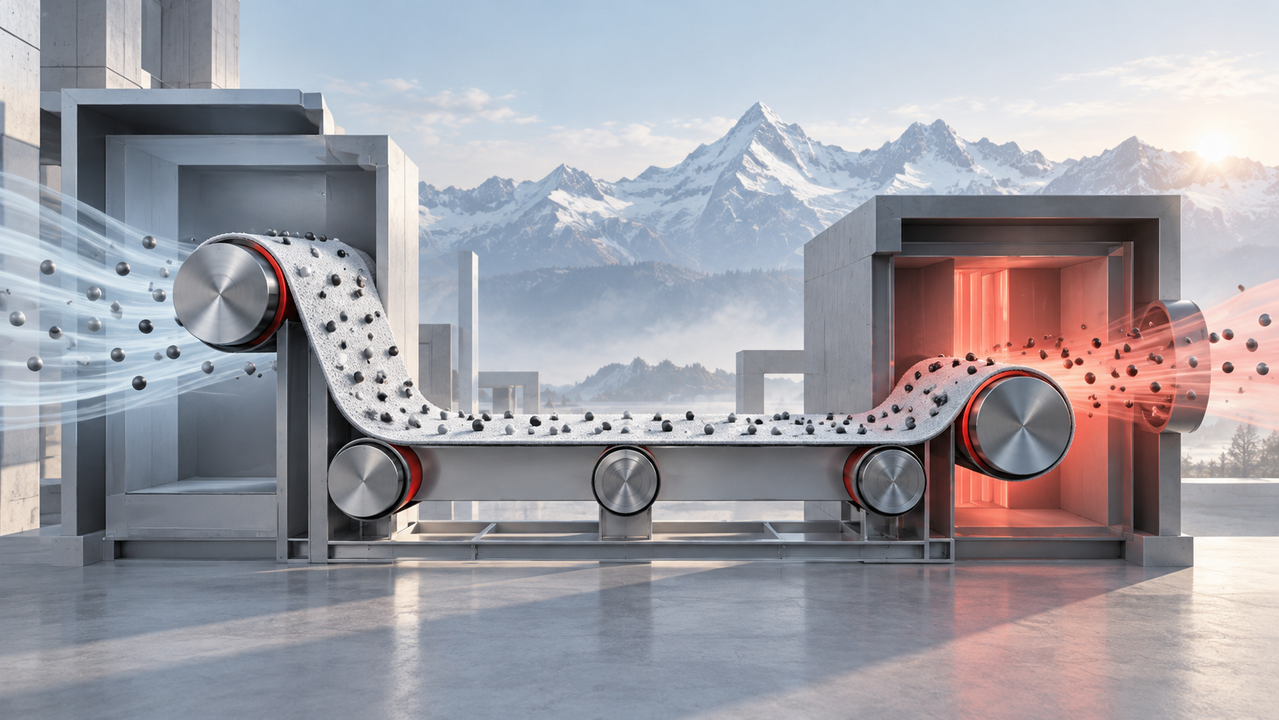
The concept resembles a conveyor belt. A coated surface continuously moves through two separate zones. In the first, ambient air passes by and CO₂ attaches to the surface. In the second, the coating is heated under reduced pressure so the gas is released in concentrated form. Because only a very thin layer needs heating, energy use could fall. Rotating cylinders might also help move the air. [1]
Not yet an operating climate technology
The work is at an early stage. Empa does not yet have the measurement platform needed to track capture and release within fractions of a second. Building that platform is the next step. Researchers will then have to test the coatings’ stability over many cycles, along with seals and pressure zones at high rotational speeds. [1]
The announcement therefore describes a scientific concept with potential, not a ready-to-deploy plant. It remains to be shown whether the method can match today’s technologies in the amount of CO₂ handled per unit of volume and time. If it succeeds, many smaller modular units could replace a few very large installations. In the longer term, the «Mining the Atmosphere» initiative also wants to turn captured carbon into useful materials and chemicals. [1]
*Image: AI-generated illustration; OpenAI / Helvetia.rocks Editorial Desk; licence: AI-generated.*