OPINION & ANALYSIS | 19 October 2026
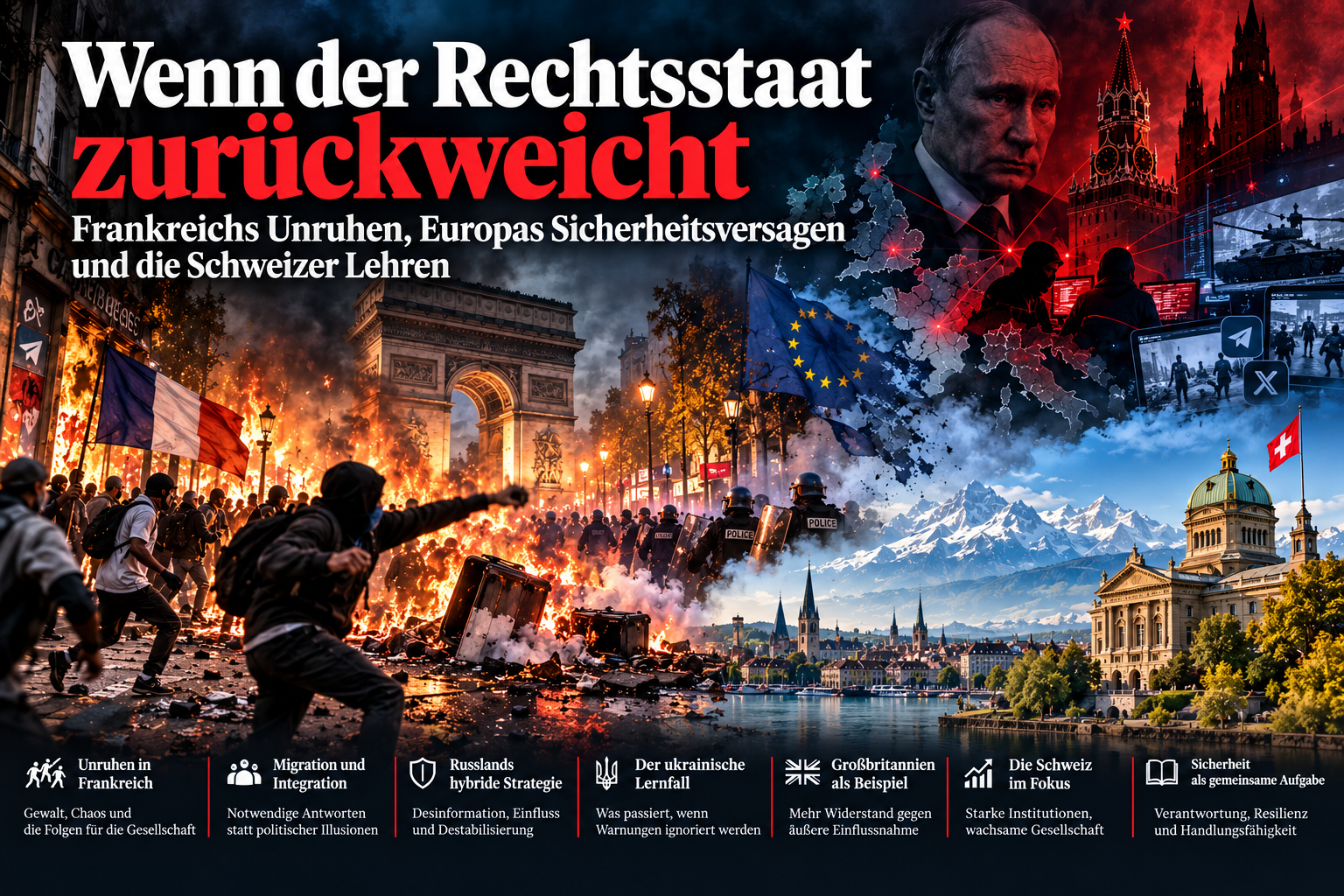
The unrest in France on 17 October is a current reason to discuss the rule of law and security. It is not, however, proof of a single political explanation. France’s interior minister said about 550,000 people took part in 110 marches; the CGT union put the figure at 800,000. Reuters reported 1,200 arrests, while the Associated Press reported about 400 on the same day. The gap reflects different times and sources. The broad picture is clear: most people protested peacefully, while violent groups attacked buildings, looted shops and started fires. On 19 October, Reuters also reported local curfews and a review of possible failures in intelligence gathering and police preparation. [1][2][3]
France: protect protest, contain violence
The right to peaceful assembly is central to a free order. It cannot justify attacks on people, businesses or public institutions. Looting, arson and violence are offences whatever political slogan is invoked. The state must nevertheless use its power proportionately. The injuries reported by AP and the review of some police operations show that security forces must also be accountable. A rule-of-law state protects rights and prosecutes offences through procedures that can be examined.
The causes of anger must not disappear from view. Living costs, energy prices, poor school conditions, overloaded public services and distrust of political decisions can explain mobilisation. They do not justify violence. Governments must identify tensions early, explain choices and measure results. The same applies to migration and integration: procedures, language learning, access to work and the enforcement of court decisions should be assessed with data. Collective blame based on origin or religion is neither compatible with the rule of law nor analytically sound.
Russia: Europe’s exposed flanks
The European Union describes hybrid threats as a combination of cyberattacks, sabotage, information manipulation, election interference and economic pressure. In its conclusions of 16 March 2026, the EU Council explicitly condemned Russian and Russia-linked campaigns. On 24 September it sanctioned, among others, Xenia Fedorova, a former RT France executive, for information-manipulation activities. These are official assessments and legal measures by the EU, not proof that every demonstration is directed from Moscow. The distinction matters: Russia can exploit existing tensions without having created every underlying cause. [4][5]
Ukraine shows the cost of strategic misjudgements. The annexation of Crimea in 2014, the war in Donbas and the full-scale invasion of 24 February 2022 were warning signs. Institutional weaknesses elsewhere may explain some decisions, but they do not excuse the aggressor. Responsibility for the war of aggression lies with Russia. Europe’s task is to take warnings seriously, reduce dependencies and strengthen resilience.
Switzerland: stability is not automatic
On 18 September 2026, the Swiss Federal Council adopted the 2026 Security Policy Strategy. It identifies Russia’s war of aggression against Ukraine, hybrid threats and critical dependencies as challenges and sets ten objectives with 46 measures. Its priorities are resilience, stronger capabilities for resistance and protection, and stronger defence capabilities. Implementation has begun; its effectiveness must still be tested through clear responsibilities, resources and measurable results. [6][7]
Swiss neutrality does not protect the country from espionage, cyberattacks, disinformation or economic pressure. Nor does it require a security logic that places legitimate criticism under suspicion. A democratic security culture should strengthen courts, media freedom, data protection and parliamentary oversight.
The current events point to five practical tasks: protect peaceful protest and public order at the same time; pursue evidence-based integration policy without collective blame; monitor hybrid risks and reduce critical dependencies; prepare reliable information and practiced crisis procedures; and cooperate with partners without outsourcing national capabilities.
The French unrest does not prove that Europe has “failed”. It shows how quickly social tension, polarisation and a state perceived as weak can erode trust. Russia is demonstrably trying to exploit such fractures, but that does not mean every conflict is controlled from abroad. Switzerland should respond neither with panic nor complacency. A state remains free when its institutions work, violence is contained, criticism is possible and security is prepared in time. The rule of law is strongest when it applies equally to authorities and protesters.
Sources: Reuters (17 and 19 October 2026), Associated Press (17 October 2026), Council of the EU (16 March and 24 September 2026), Swiss Federal Council and SEPOS (18 September 2026). The image is an AI-generated symbolic illustration.