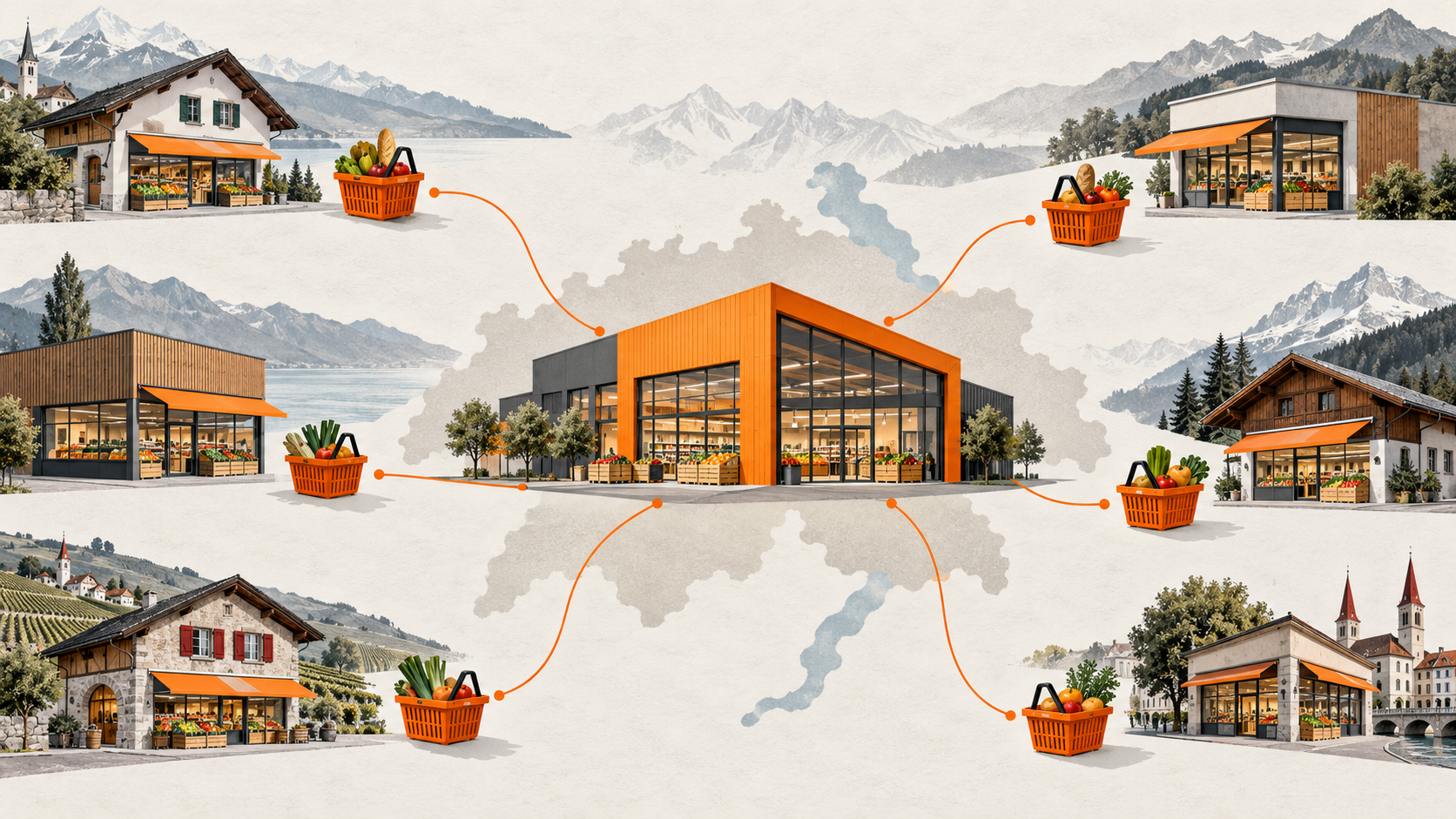
Migros is planning a major overhaul of its cooperative structure. The ten legally independent regional cooperatives and the Migros Cooperative Federation (MCF) would be brought together under one group cooperative. “Single cooperative” is common shorthand; Migros calls the proposed body a group cooperative. On 26 October, the boards of all ten regional cooperatives and the MCF unanimously backed the plan in principle. The merger has not yet been approved. [1][2]
Migros Bank is explicitly listed as a business unit in its own right. It would continue to run its day-to-day business; the group cooperative would set overall strategy, allocate financial resources and monitor risks. Migros has announced no changes to bank accounts or services. [2]
What would change
Today, the ten regional cooperatives are autonomous, while the MCF coordinates the group. Under the proposal, one national cooperative would sit above seven largely independent business units: Migros Supermarket, Migros Industry, Denner, Migrol and Migrolino, Digitec Galaxus, Migros Bank and Medbase. The units would continue to run day-to-day operations. Supermarkets would be managed nationally and organised into five regions. [1][2]
Migros cites stronger competition and parallel administrative and management structures. A simpler organisation is intended to speed up decisions, pool investment and enable better or cheaper offers. Those are the company’s stated goals; the actual effect on prices and customers will only become clear after implementation. [1][3]
Coop carried out a comparable consolidation in 2001: its annual report says the 14 regional cooperatives at the time merged with Coop Switzerland in January to form one cooperative. That was 25 years before Migros’s current proposal. The basic idea is similar, though the specific structures are not identical. [5]
Regional representation
The ten current cooperative councils, with about 500 members, would be replaced by six regional councils with roughly 300 members altogether. They would represent local concerns and elect delegates to a national assembly. Migros says regional products, local partnerships and its cultural fund will continue. Funding would keep flowing back to the regions where it was generated. [2]
Migros says regional ties will remain, but formal representation would be more concentrated nationally. Whether six councils can reflect the diversity of the ten existing cooperatives will be a key issue in the debate.
The vote and staff impact
The roughly 2.3 million cooperative members are due to vote in mid-2027. Migros says at least 25% of eligible voters must participate and a two-thirds majority is required. The current structure remains in place until then. If members approve the plan, the transition will take several years. [2]
Migros says changes would mainly affect administration and management, not store employees. It promises no redundancies linked to the reorganisation in the regional cooperatives until at least mid-2028. It has not given a total figure for possible job changes after that date. MCF chief executive Mario Irminger and Migros Supermarket head Peter Diethelm plan to leave their posts when the vote takes place. [1][4]
**As of 27 October 2026:** the boards have unanimously endorsed the proposal in principle, but members have not yet voted.