OPINION & ANALYSIS | 19 October 2026
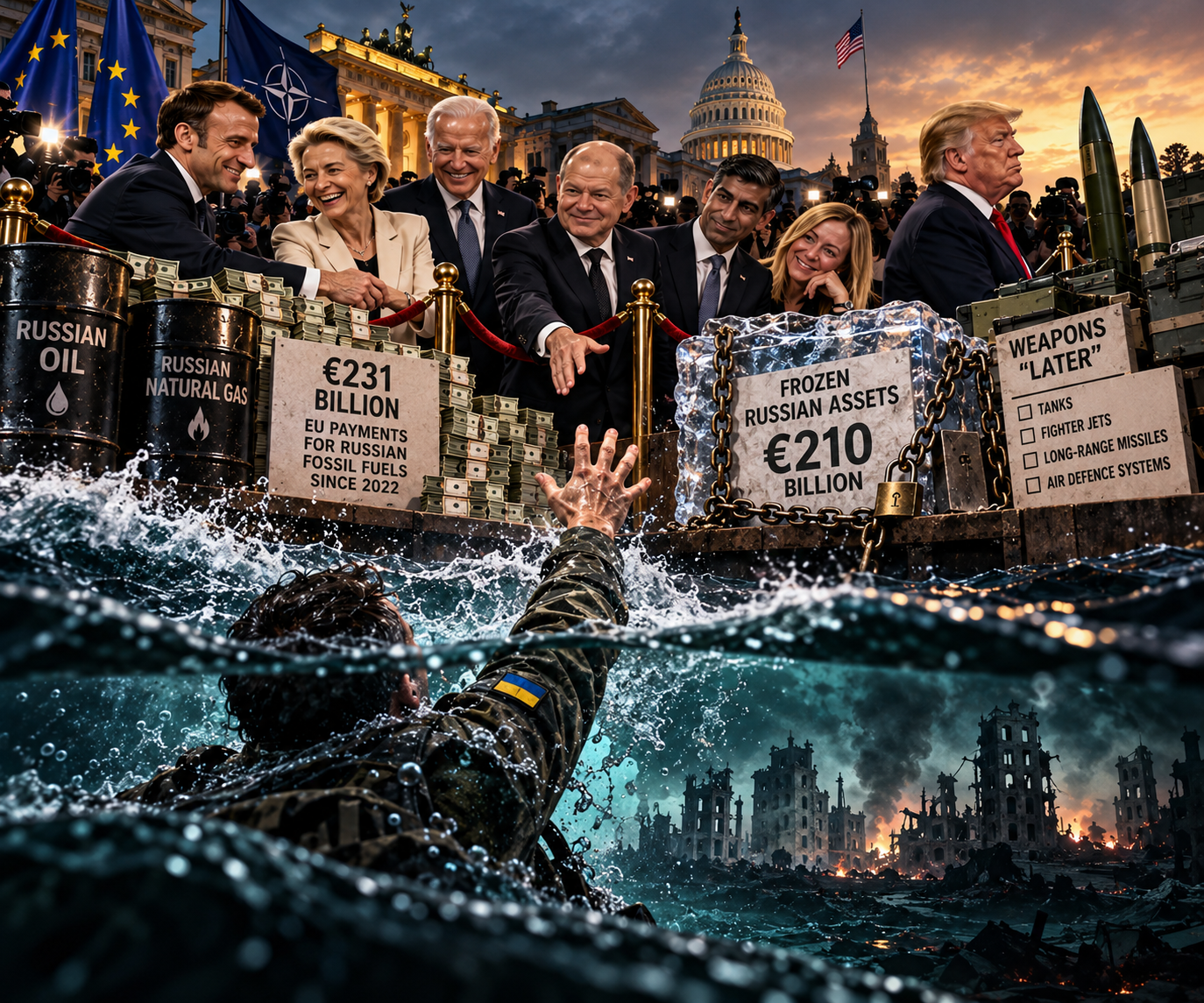
A person is drowning. People on the bank can see it. They explain that the water is cold, their clothes are expensive and jumping in could prevent them from meeting other obligations. Perhaps they will help later. The person in the water needs help now.
The metaphor is deliberately stark. States have to weigh escalation risks, their own security, legal constraints and economic consequences. Not every delay proves bad faith. One question remains: what does political solidarity mean when decisions arrive after the opportunity for effective help has narrowed?
In a Times column published on 17 October 2026, the British journalist Matthew Syed asked that question. He criticised photographs of embraces and Western promises when decisions and deliveries then moved slowly or arrived with limits. That is a political judgement, not proof that every supporter of Ukraine is deliberately deceiving the public. It is a reason to compare words with actions. [1]
Hugs are not a strategy
Visits to Kyiv, joint statements and public solidarity matter. They keep international attention on the war and show Ukrainians that they are not alone. Support also has concrete effects: the EU Council records substantial financial, military and humanitarian contributions from the Union and its member states since Russia’s full-scale invasion. Criticism should not erase those efforts. It can still ask whether they were timely, sufficient and reliable. [2]
Deliveries of aircraft, Leopard tanks, air-defence systems and long-range missiles were often preceded by lengthy debates. In many cases decisions were eventually taken. Timing remains decisive. In war, time is a resource: equipment that arrives before a position is lost has a different value from the same equipment delivered months later.
No serious analyst can claim that an earlier delivery would certainly have changed the course of the war. The outcome depends on many factors. That does not make delays irrelevant. Anyone citing escalation risk must also explain the opposite risk: that Russia exploits hesitation, prepares further attacks and deprives Ukraine of lives, territory and room for manoeuvre.
Not every caution is hypocrisy
An open rejection of military aid can be criticised, but it is at least clear. The issue is different when governments announce support without restrictions and later create exceptions, delays or political conditions. It is legitimate to ask what costs they are actually prepared to bear.
The same question applies to energy. Europe has reduced its dependence on Russia, but economic ties do not disappear overnight. The legality of a particular import depends on the product, date, legal basis and any exception. An import alone therefore does not prove hypocrisy. When governments promise maximum economic pressure and retreat when prices rise, however, a gap opens between principle and practice.
Ukraine pays for Russia’s war of aggression with destroyed cities, deaths and an exhausted society. European households mainly face higher costs and the restructuring of their economies. These situations are not equivalent. The difference nevertheless explains why solidarity can weaken when it becomes visible in daily life.
210 billion euros: revenue is not the principal
The conflict is especially clear in the debate over immobilised Russian central-bank assets. According to the EU Council, around 210 billion euros of these assets are held in the Union. The EU is already using extraordinary revenue: around eight billion euros in windfall profits have reportedly been generated, with 3.8 billion euros reaching Ukraine; other amounts service or secure EU and G7 loans. [2][3]
The assets themselves, the principal, must be distinguished from that revenue. Their direct use or confiscation remains legally and politically contested. Belgium, where a large share is held, is seeking guarantees and risk sharing. That caution is not automatically an excuse. Property rights, retaliation and consequences for the international financial system have to be examined.
Complexity must not become a reason for indefinite inaction. The European Parliamentary Research Service reported in October 2026 that several states were again discussing broader use of the assets because of additional financing needs. The political task is to create a lawful and durable mechanism. Ukraine needs decisions while it is financing defence, public services and reconstruction, not only after political pressure has eased. [4]
Clear positions can be challenged; hypocrisy must be examined
States do not have the same means or the same responsibilities. Their contributions should be assessed by their capacity, decisions and timing. A government that opposed military aid from the start has a clear position. It may be politically wrong, but it is not automatically hypocritical.
Hypocrisy becomes a legitimate question when public promises and actions diverge over time. Leaders must then explain why they waited, what alternatives they considered and who bore the risk of the delay.
Ukraine must not become an instrument through which other states contain Russia without accepting their own responsibility. It is a sovereign state. Its people have a right to protection, freedom and the ability to decide their future. Support should therefore be judged by verifiable commitments, reliable delivery chains and a realistic assessment of risk.
Late help is still help. It can save lives and support the state. It cannot restore what was lost in the meantime. Solidarity is therefore measured less by the number of embraces than by decisions taken while they can still make the greatest difference.
Sources: The Times (17 October 2026), Council of the EU (page reviewed 14 October 2026), EEAS (6 August 2026) and the European Parliamentary Research Service (October 2026). The image is an AI-generated symbolic illustration.