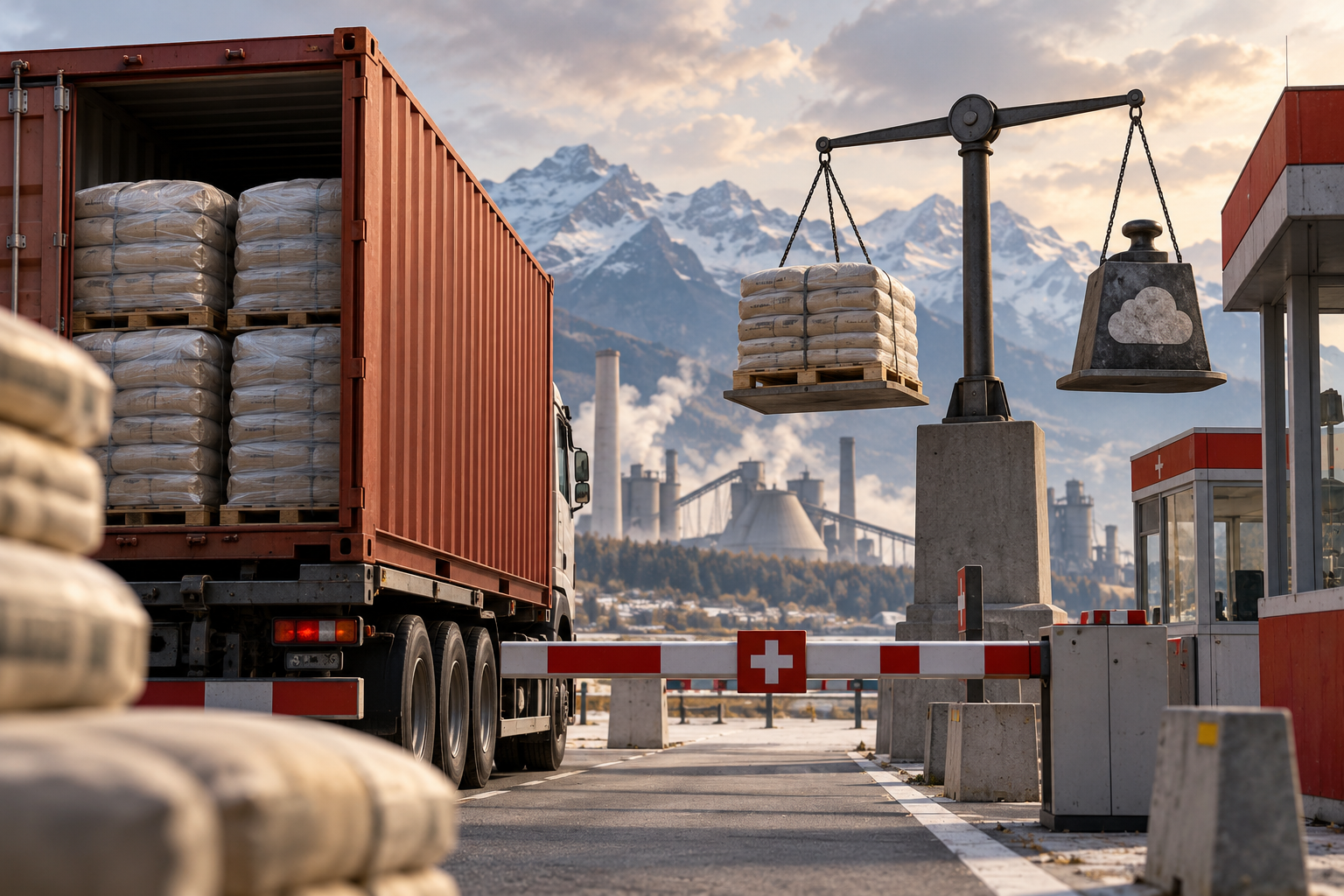
The Federal Council supports in principle a Swiss carbon border adjustment for imported cement products. On 21 October 2026, it recommended that Parliament approve the bill drafted by the National Council’s environment committee. The measure is intended to prevent cement production and its emissions from moving to countries where producers pay substantially less for carbon. [1]
Comparable carbon costs at the border
Swiss cement plants participate in the emissions trading system linked to that of the European Union. They must surrender allowances for their emissions, while the share allocated free of charge will be reduced step by step until 2034. Producers outside Europe do not face the same obligation. Imported cement can therefore gain a cost advantage even though its production also releases greenhouse gases. [1]
The proposed mechanism is limited to cement. According to the federal authorities, cement accounts for the highest carbon emissions among the sectors covered by Switzerland’s system. Importers would declare the relevant information themselves and the Confederation would issue a corresponding invoice. The aim is to keep enforcement as simple as possible. [1]
A trigger before application
Despite supporting the proposal, the Federal Council warns of foreign-trade risks. A Swiss border measure sends trade-policy signals and may affect relations with third countries. It should therefore not apply automatically, but only if cement imports from such countries rise sharply. The release does not specify a numerical threshold. [1]
The proposal is not yet law. Parliament must decide on both the bill and the recommended trigger. The size of any charge, the point of activation and the detailed evidence required from importers therefore remain open.
The central policy trade-off is clear: Swiss climate costs should not drive production abroad, but a new trade instrument should not be activated before the risk has materially increased.
*Image: AI-generated illustration; OpenAI / Helvetia.rocks Editorial Desk; licence: AI-generated.*